

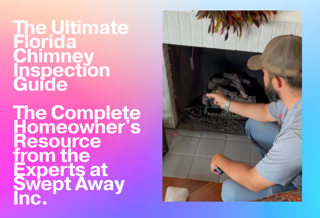
Everything Tampa Bay Homeowners Need to Know Before Using Their Fireplace
The Complete Homeowner’s Resource from the Experts at Swept Away Inc.
Introduction
Most homeowners don’t think about their chimney until something goes wrong.
Maybe smoke starts spilling into the living room. Maybe water begins dripping into the fireplace after a heavy Florida thunderstorm. Maybe a home inspector recommends a Level 2 chimney inspection during a real estate transaction. Or perhaps you’re getting ready for cooler weather and realize the fireplace hasn’t been used in several years.
Whatever brought you here, one thing is certain:
A chimney is not a “set it and forget it” part of your home.
Every time you burn a fire, your chimney is exposed to temperatures that can exceed 1,000°F. Every day, it withstands Florida’s intense UV rays, wind-driven rain, high humidity, salt-laden coastal air, and severe summer storms. Over time, these conditions take a toll on masonry, metal components, chimney liners, and waterproofing systems.
Unlike your roof or HVAC system, chimney problems often develop silently. Damage can remain hidden for years until it suddenly results in expensive repairs, dangerous chimney fires, water intrusion, or carbon monoxide entering the home.
Unfortunately, many homeowners believe that if smoke goes up the chimney, everything must be working correctly.
That assumption can be costly.
We’ve inspected chimneys that appeared perfectly normal from the living room, only to discover collapsed flue liners, severe creosote accumulation, rusted chase covers, cracked chimney crowns, and bird nests completely blocking the flue. We’ve also inspected chimneys after hurricanes where homeowners had no idea that wind had loosened the chimney cap or driven water deep into the masonry system.
These are not rare occurrences—they’re everyday findings for professional chimney technicians.
At Swept Away Inc., we’ve inspected and serviced thousands of fireplaces and chimneys throughout Tampa, St. Petersburg, Clearwater, Largo, Palm Harbor, Dunedin, Seminole, Safety Harbor, Brandon, Wesley Chapel, and communities across Pinellas, Hillsborough, and Pasco Counties. Every inspection teaches us something new about how Florida’s unique climate affects chimney systems.
This guide brings together that experience into one comprehensive resource.
Whether you’re a first-time homeowner, preparing to buy or sell a house, maintaining an investment property, or simply wanting to enjoy your fireplace safely, this guide will help you understand:
- How a chimney actually works
- Why annual inspections are recommended
- The differences between Level 1, Level 2, and Level 3 inspections
- What problems inspectors look for
- Why Florida chimneys deteriorate differently than chimneys in colder climates
- The warning signs of hidden damage
- When repairs are necessary
- How to extend the life of your chimney system
- What to expect during a professional inspection
By the time you finish reading, you’ll understand more about chimney systems than most homeowners ever will—and you’ll know exactly what to look for to keep your fireplace operating safely for years to come.
Why This Guide Exists
There’s a surprising amount of misinformation online about chimney maintenance.
Some websites claim chimneys only need cleaning when they’re dirty. Others recommend inspections every few years instead of annually. Many articles are written by marketing companies with little practical field experience, often recycling the same generic advice.
At Swept Away Inc., we wanted to create something different.
This isn’t just another blog written for search engines.
It’s a practical, experience-based guide built from thousands of real inspections performed throughout the Tampa Bay area.
Throughout this article, we’ll share:
- Common problems we encounter during inspections
- Why certain chimney failures happen
- What homeowners can do to prevent expensive repairs
- How Florida weather affects chimney systems
- When repairs should be made immediately—and when they can wait
- What separates a thorough inspection from a quick visual glance
Our goal isn’t simply to tell you that you need a chimney inspection. Our goal is to help you understand whyinspections matter and how they protect both your home and your family.
What Is a Chimney Inspection?
Many homeowners picture a chimney inspection as someone shining a flashlight up the fireplace for a few minutes.
A professional inspection is far more involved.
A chimney inspection is a systematic evaluation of the entire fireplace and venting system to determine whether it can safely contain heat, smoke, toxic gases, and combustion byproducts while protecting the structure of the home.
Depending on the level of inspection being performed, technicians may evaluate:
- Firebox condition
- Smoke chamber
- Damper operation
- Flue liner integrity
- Chimney cap
- Crown
- Masonry
- Chase cover
- Flashing
- Exterior brickwork
- Mortar joints
- Waterproofing
- Clearance to combustibles
- Evidence of previous chimney fires
- Animal intrusion
- Water damage
- Creosote accumulation
- Structural movement
- Vent connector condition
- Appliance compatibility
- Proper drafting characteristics
Many inspections today also include specialized camera systems capable of viewing the entire interior length of the chimney. These high-resolution cameras allow technicians to identify cracks, gaps, liner separations, hidden obstructions, and deterioration that cannot be seen with the naked eye.
Think of it as the difference between looking at your teeth in the mirror versus having dental X-rays taken. One provides a surface-level view; the other reveals hidden conditions that could become serious if left untreated.
A thorough inspection documents both current conditions and potential concerns, allowing homeowners to make informed decisions about maintenance and repairs before small issues become major expenses.
Why Every Fireplace Needs an Inspection—Even If You Rarely Use It
One of the most common questions we hear is:
“I only use my fireplace a few times each year. Do I still need it inspected?”
The answer is yes.
Many of the problems found during chimney inspections have little to do with how often the fireplace is used.
Florida’s environment is often a greater threat than fire itself.
Even an unused chimney is constantly exposed to:
- Heavy rainfall
- Tropical storms
- Hurricanes
- Salt air (especially near the Gulf)
- High humidity
- Extreme heat
- UV exposure
- Wind-driven debris
- Nesting birds
- Squirrels
- Raccoons
- Insects
- Corrosion
- Masonry expansion and contraction
Over months and years, these forces gradually break down the chimney system.
A cracked chimney crown can allow water to enter the masonry. Moisture freezes less often in Florida than northern states, but repeated wetting and drying cycles still weaken mortar and brick. Rust develops on metal components such as chase covers and dampers. Small openings become entry points for animals. Hidden leaks stain interior walls, ceilings, and fireplace surrounds.
Many homeowners discover these problems only after they become expensive.
Routine inspections help identify deterioration early, when repairs are typically simpler and less costly.
The Cost of Waiting
One of the biggest misconceptions in home maintenance is that postponing an inspection saves money.
In reality, delaying maintenance often increases repair costs.
Consider this common progression:
A chimney cap is damaged during a summer thunderstorm.
Rain enters the flue unnoticed.
Moisture reaches the smoke chamber.
Rust forms on the damper.
The chimney crown develops hairline cracks.
Water continues entering each storm.
Mortar joints begin deteriorating.
The flue liner weakens.
Interior drywall develops stains.
Wood framing remains damp.
Mold begins growing behind finished surfaces.
By the time the homeowner notices a problem, what could have been a straightforward cap replacement may now require multiple repairs involving masonry, waterproofing, metal components, and interior finishes.
Routine inspections help interrupt that cycle before damage spreads.
Part 2: How a Chimney Works (And Why Florida Chimneys Fail Differently)
Understanding Your Chimney: More Than Just a Brick Stack
Ask the average homeowner what a chimney does, and they’ll probably say:
“It lets the smoke out.”
While technically true, that’s only part of the story.
A properly functioning chimney is a carefully engineered system designed to safely move smoke, heat, water vapor, toxic combustion gases, and microscopic particles from your fireplace to the outdoors. At the same time, it must protect your home’s structure from extreme temperatures, moisture, and fire.
If even one component fails, the entire system can become compromised.
That’s why professional chimney inspections evaluate the complete system, not just the visible brickwork or the fireplace itself.
At Swept Away Inc., we often explain it this way:
Your chimney is to your fireplace what your heart and arteries are to your body. If the pathway becomes restricted or damaged, the entire system suffers.
The Science Behind Chimney Draft
One of the most misunderstood concepts in fireplace operation is draft.
Draft is the natural upward movement of hot gases inside the chimney.
When you light a fire, the air inside the flue heats rapidly. Hot air becomes less dense than the cooler outdoor air surrounding the chimney. Because it is lighter, the heated air rises, creating negative pressure that continuously pulls fresh combustion air into the fireplace while carrying smoke safely outdoors.
This natural process is often called the stack effect.
Without adequate draft:
- Smoke enters your home.
- Carbon monoxide may accumulate.
- Fires burn inefficiently.
- Creosote forms much more quickly.
- The fireplace becomes difficult—or even dangerous—to operate.
Why Draft Problems Are So Common in Florida
Florida presents unique challenges that homeowners in northern states rarely encounter.
Warm Outdoor Temperatures
In colder climates, the temperature difference between the fire and the outdoor air is significant, creating strong draft.
Florida’s mild winters reduce that temperature difference, making it harder for chimneys to establish proper draft—especially during the first few minutes after lighting a fire.
High Humidity
Moist air is heavier than dry air.
Florida’s humidity can reduce draft efficiency while contributing to condensation inside the chimney, particularly during seasonal temperature swings.
Wind Patterns
Many Tampa Bay homes experience changing coastal winds.
Depending on roof design and nearby trees, wind may actually push air down the chimney instead of allowing smoke to exit.
This phenomenon, known as downdrafting, is one of the most common complaints we investigate.
Tight Modern Homes
Today’s energy-efficient homes leak much less air than older homes.
While that’s good for energy bills, fireplaces rely on replacement air.
If your home cannot provide enough makeup air, the fireplace competes with:
- Kitchen exhaust fans
- Bathroom fans
- Clothes dryers
- HVAC systems
The result?
Smoke often spills into the living room.
Anatomy of a Masonry Chimney
To understand what inspectors evaluate, it’s helpful to know the major components of the system.
We’ll start where the fire begins and work upward.
Firebox
The firebox is the chamber where wood burns.
Its refractory brick and specialized mortar are designed to withstand repeated exposure to temperatures exceeding 1,000°F.
During inspections we look for:
- Cracked firebrick
- Missing mortar joints
- Loose refractory panels
- Heat damage
- Improper repairs
- Evidence of previous chimney fires
Small cracks can allow excessive heat to reach combustible framing hidden behind the fireplace.
Many homeowners never notice this damage because the firebox still “looks fine” from a distance.
Photo Opportunity
(Insert close-up photo of cracked refractory brick from a Swept Away inspection.)
Suggested Caption:
“Even small cracks in firebrick can expose the surrounding structure to excessive heat if left unrepaired.”
Damper
The damper acts like a valve.
Open it before burning a fire.
Close it after the fireplace has completely cooled.
A properly operating damper:
- Improves draft
- Prevents conditioned air loss
- Keeps rain out (to a degree)
- Reduces insect entry
- Helps keep animals out
Unfortunately, Florida’s humidity frequently causes dampers to rust.
We commonly find:
- Frozen dampers
- Broken hinges
- Missing handles
- Heavy corrosion
- Improper sealing
Many homeowners don’t realize their damper has failed until their heating and cooling bills increase.
Smoke Chamber
Few homeowners even know this part exists.
The smoke chamber sits directly above the firebox.
Its purpose is to funnel smoke smoothly into the flue.
Ideally, the smoke chamber should have smooth, parged walls that allow combustion gases to flow efficiently.
Instead, we often find:
- Rough masonry
- Excess mortar protrusions
- Gaps
- Missing parging
- Heavy creosote deposits
These rough surfaces slow airflow and encourage creosote buildup.
Why This Matters
Think of the smoke chamber like the intake manifold on an engine.
If airflow becomes turbulent, efficiency drops dramatically.
Smoke Shelf
The smoke shelf is a horizontal ledge located behind the damper.
Its job is surprisingly important.
It helps:
- Reduce downdrafts
- Collect debris
- Catch rainwater before it reaches the firebox
- Trap small amounts of soot
Unfortunately, it also becomes the perfect place for:
- Leaves
- Bird nests
- Dead animals
- Construction debris
- Broken chimney tile
- Large creosote deposits
This area is often invisible without specialized inspection equipment.
Flue Liner
The flue liner is arguably the most important safety component in the entire chimney.
Its job is to:
- Contain heat
- Protect masonry
- Prevent carbon monoxide leakage
- Improve draft
- Reduce creosote accumulation
There are several common liner types:
Clay Tile
Most older Florida homes use clay tile liners.
Advantages:
- Long lifespan
- Affordable
- Fire resistant
Disadvantages:
- Brittle
- Cracks with age
- Susceptible to water damage
- Difficult to repair
Stainless Steel
Many restored chimneys receive stainless steel liners.
Advantages:
- Excellent durability
- Better draft
- Compatible with modern appliances
- Highly corrosion resistant
These are often the preferred option when an existing clay liner has failed.
Cast-in-Place Systems
Less common but occasionally found in major restoration projects.
Why We Camera Inspect Flue Liners
A flashlight cannot reveal the entire condition of a liner.
Small cracks may only be visible from certain angles.
Camera inspections allow us to identify:
- Missing mortar joints
- Broken clay tiles
- Offsets
- Obstructions
- Previous chimney fire damage
- Improper repairs
- Water intrusion
- Hidden deterioration
Many liner failures are invisible from both the fireplace and the roof.
Without a camera, these issues can easily go unnoticed.
Photo Opportunity
(Insert screenshot from a chimney camera inspection showing a cracked flue tile.)
Chimney Crown
The chimney crown sits at the very top of the masonry chimney.
Many homeowners mistakenly call this the “cap.”
It is not.
The crown is a concrete or mortar surface designed to shed water away from the chimney.
Its responsibilities include:
- Preventing water entry
- Protecting brickwork
- Supporting the flue
- Directing rain away from mortar joints
In Florida, chimney crowns are one of the most frequently damaged components we inspect.
Common Crown Problems
- Hairline cracking
- Major cracking
- Missing sections
- Poor slope
- Improper repairs
- Freeze damage (rare but possible)
- UV deterioration
- Water penetration
Once water enters through a damaged crown, deterioration accelerates rapidly.
Chimney Cap
The chimney cap is the metal covering installed over the flue opening.
Think of it as your chimney’s umbrella.
A quality stainless steel chimney cap helps:
- Keep rain out
- Prevent birds from nesting
- Stop squirrels and raccoons from entering
- Reduce downdrafts
- Contain sparks
- Protect the flue liner
One of the biggest mistakes we see is homeowners installing inexpensive, thin-gauge imported caps that begin rusting within a few years in Florida’s humid, salty environment.
At Swept Away, we often recommend UL-listed stainless steel chimney caps because they provide superior durability and corrosion resistance for our coastal climate.
Photo Opportunity
Include a side-by-side comparison:
- Rusted low-cost cap
- Premium stainless steel cap
This type of original image builds trust and demonstrates firsthand experience.
Chase Cover (Factory-Built Fireplaces)
Many Tampa Bay homes have prefabricated fireplaces rather than full masonry chimneys.
These systems use a chase cover instead of a masonry crown.
The chase cover seals the top of the framed chimney enclosure while allowing the flue to pass through.
When chase covers fail, homeowners often experience:
- Ceiling stains
- Interior leaks
- Rust
- Mold
- Wood rot
- Damaged insulation
We routinely find galvanized chase covers that have rusted through after years of exposure to Florida’s weather. Replacing them with custom-fabricated stainless steel chase covers is often a long-term solution.
Why Florida Chimneys Fail Differently
If you read national fireplace advice, you’ll notice much of it focuses on snow, ice dams, and freeze-thaw cycles.
Those are not the primary concerns in Tampa Bay.
Instead, our inspections are dominated by:
Water Intrusion
Water is the number one enemy of Florida chimneys.
Every afternoon thunderstorm, tropical system, and hurricane tests the chimney’s ability to keep moisture out.
Once water enters the system, damage can spread far beyond the chimney itself.
Salt Air Corrosion
Homes near Clearwater Beach, Madeira Beach, Treasure Island, Indian Rocks Beach, St. Pete Beach, Pass-a-Grille, and other Gulf communities face accelerated corrosion.
Salt-laden air attacks:
- Chimney caps
- Chase covers
- Dampers
- Flashing
- Fasteners
- Fireplace accessories
Using marine-grade or high-quality stainless steel components is often worth the investment in these environments.
Hurricanes and Severe Storms
High winds can:
- Loosen chimney caps
- Damage chase covers
- Crack crowns
- Dislodge flashing
- Drive rain into tiny openings
- Blow debris into flues
Even if your roof appears undamaged after a major storm, your chimney may have sustained hidden damage that warrants inspection.
UV Exposure
Florida’s intense sunlight accelerates the deterioration of:
- Sealants
- Waterproof coatings
- Paint finishes
- Certain masonry repair materials
Products that perform well in northern climates may fail much sooner here if they’re not designed for prolonged UV exposure.
The Bottom Line
A chimney is far more than a decorative feature—it is a safety system exposed to heat, moisture, weather, and time every single day.
Understanding how each component works helps explain why a thorough inspection is so important. Many serious defects begin out of sight, and by the time symptoms appear inside the home, the damage is often much more extensive.
At Swept Away Inc., every inspection is approached as a complete system evaluation. Our goal is not simply to identify problems, but to help homeowners understand their chimney, prioritize repairs when needed, and keep their fireplace operating safely for years to come.
Part 3: Why Annual Chimney Inspections Matter
The Hidden Dangers Every Florida Homeowner Should Understand
“I’ve Never Had My Chimney Inspected… and Nothing Has Happened.”
We hear this all the time.
“We’ve lived here for 20 years.”
“We only use the fireplace at Christmas.”
“Everything seems to work fine.”
“It’s always been that way.”
Unfortunately, chimneys rarely announce when something is wrong.
Unlike a leaking water heater or a broken air conditioner, chimney problems often develop slowly and silently. A chimney can appear perfectly normal while hidden defects continue to worsen with every passing season.
Some of the most serious issues we uncover during inspections show no visible signs from inside the home.
We’ve inspected fireplaces that drafted normally but had:
- Cracked clay flue tiles
- Heavy glazed creosote deposits
- Missing mortar joints
- Water-damaged smoke chambers
- Rusted-out chase covers
- Bird nests hidden above the damper
- Chimney caps barely hanging on after storms
- Large gaps capable of allowing heat and combustion gases to reach combustible framing
The homeowner had no idea.
That’s exactly why annual inspections are recommended.
A Chimney Is Always Aging—Even When You Don’t Use It
Many homeowners assume a fireplace only deteriorates when it’s used.
In reality, most Florida chimneys spend far more time battling weather than fire.
Every day, your chimney is exposed to:
- Summer thunderstorms
- Tropical downpours
- Hurricane-force winds
- Salt-laden Gulf air
- High humidity
- UV radiation
- Airborne pollutants
- Thermal expansion from Florida’s intense heat
- Wildlife looking for shelter
Think of your chimney like the roof on your home.
Even if you never climb onto your roof, the shingles still age.
The same principle applies to your chimney.
Fire Doesn’t Cause Most Chimney Damage
This surprises many homeowners.
While chimney fires are certainly dangerous, water causes more chimney damage than fire in Florida.
Water enters through:
- Cracked crowns
- Missing chimney caps
- Rusted chase covers
- Failed flashing
- Deteriorated mortar joints
- Cracked masonry
- Failed waterproofing
Once moisture gets inside, it begins attacking nearly every component of the chimney.
Water can:
- Rust dampers
- Corrode metal fireboxes
- Deteriorate mortar
- Crack masonry
- Destroy chase covers
- Damage framing
- Stain ceilings
- Create mold conditions
- Weaken flue liners
One small leak today can become a major restoration project within a few years.
The Three Biggest Safety Hazards We Look For
Professional chimney inspections focus on identifying hazards before they become emergencies.
Let’s look at the three most common.
1. Creosote Buildup
Every wood-burning fire produces smoke.
Inside that smoke are:
- Water vapor
- Unburned gases
- Tars
- Organic compounds
- Tiny soot particles
As the smoke cools inside the chimney, these materials condense onto the flue walls.
The result is creosote.
Stage One Creosote
Fresh soot.
Usually black or brown.
Relatively easy to remove.
Still combustible.
Stage Two Creosote
Harder.
Flaky.
Crunchy.
More difficult to remove.
Higher fire risk.
Stage Three Creosote
Often called glazed creosote.
This is the dangerous one.
It becomes:
- Thick
- Hard
- Shiny
- Tar-like
- Extremely combustible
Removing glazed creosote often requires specialized equipment and techniques beyond standard sweeping.
Why Creosote Is Dangerous
Creosote is fuel.
If temperatures become high enough, it can ignite inside the chimney.
A chimney fire may reach temperatures exceeding 2,000°F.
At those temperatures:
- Clay liners crack
- Stainless liners warp
- Mortar fails
- Masonry expands
- Nearby framing may ignite
- The entire chimney system can sustain permanent damage
Some chimney fires sound like a freight train.
Others happen quietly.
Many homeowners never realize they’ve experienced one.
Warning Signs of a Previous Chimney Fire
During inspections we may find:
- Cracked flue tiles
- Puffy creosote deposits
- Warped dampers
- Melted metal
- Broken mortar joints
- Smoke escaping into attic spaces
- Severe discoloration
These are signs the chimney should not be used until properly evaluated and repaired.
Photo Opportunity
(Insert photos showing the progression from light soot to glazed creosote.)
Suggested Caption:
“Not all creosote looks the same. As buildup progresses, removal becomes more difficult and the risk of chimney fire increases.”
2. Carbon Monoxide
Carbon monoxide is often called the silent killer.
It has:
- No smell
- No taste
- No color
When combustion gases fail to exit the chimney properly, carbon monoxide can accumulate inside the home.
Possible causes include:
- Blocked flues
- Animal nests
- Damaged liners
- Draft problems
- Collapsed masonry
- Improper appliance venting
Symptoms may include:
- Headaches
- Dizziness
- Fatigue
- Nausea
- Confusion
Many homeowners mistake these symptoms for the flu.
Professional inspections help identify conditions that could allow combustion gases to enter the living space.
3. Structural Deterioration
A chimney supports thousands of pounds of masonry.
Over time, damage accumulates.
We commonly inspect:
- Leaning chimneys
- Loose bricks
- Missing mortar
- Crown failures
- Spalling masonry
- Rusted lintels
- Separation from the home
- Settlement cracks
Some problems are cosmetic.
Others affect structural stability.
An inspection helps distinguish between the two.
Why Annual Inspections Save Money
Homeowners sometimes view inspections as an expense.
We encourage them to think of inspections as an investment in preventive maintenance.
Here’s a common example.
Scenario A
A routine inspection identifies a cracked chimney crown.
Repair cost:
A few hundred dollars.
The crown is sealed before water enters the system.
Problem solved.
Scenario B
The crack goes unnoticed for several years.
Rain enters the chimney.
Moisture reaches the liner.
The chase cover rusts.
Interior drywall stains appear.
Masonry begins deteriorating.
Now the homeowner may need:
- Crown replacement
- Waterproofing
- Masonry repairs
- Chase cover replacement
- Interior repairs
- Flue liner repairs
The cost can be several times higher than addressing the issue early.
The lesson isn’t that every inspection finds major problems—it’s that inspections help identify small problems before they become large ones.
Why “Everything Looks Fine” Isn’t Enough
A visual glance into the fireplace tells only a small part of the story.
Many critical areas are hidden.
These include:
- The upper flue
- Interior liner joints
- Smoke chamber surfaces
- The top of the crown
- Flashing details
- Chase cover seams
- Attic clearances
- Areas above the damper
This is why professional inspections often include specialized cameras, mirrors, ladders, and roof access when appropriate.
Home Buyers: Don’t Skip the Chimney Inspection
Real estate transactions are one of the most common reasons homeowners schedule chimney inspections.
A general home inspection is valuable, but it is not the same as a dedicated chimney inspection.
General home inspectors evaluate many systems in a limited amount of time.
A chimney specialist focuses exclusively on the fireplace and venting system.
For buyers, a professional inspection can reveal:
- Hidden safety concerns
- Needed repairs
- Water intrusion
- Liner damage
- Improper modifications
- Deferred maintenance
Knowing these conditions before closing allows buyers and sellers to negotiate repairs or costs with better information.
After a Hurricane, Your Chimney May Need Attention
Living in Tampa Bay means preparing for tropical storms and hurricanes.
High winds can:
- Shift chimney caps
- Damage flashing
- Crack crowns
- Loosen masonry
- Drive rain into small openings
- Deposit debris into the flue
Even if you don’t see visible damage from the ground, an inspection after a significant storm can help identify issues that may otherwise remain hidden until leaks develop.
How Often Should a Chimney Be Inspected?
The National Fire Protection Association (NFPA 211) recommends that chimneys, fireplaces, vents, and solid-fuel-burning appliances be inspected at least once each year to verify that they are structurally sound, free from deposits, and clear of obstructions.
An inspection does not automatically mean a cleaning is needed.
Likewise, a chimney that looks clean may still require repairs.
Each service addresses a different aspect of chimney maintenance.
Common Reasons Homeowners Schedule an Inspection
At Swept Away Inc., we regularly perform inspections because homeowners are:
- Purchasing a home
- Selling a home
- Preparing for fireplace season
- Experiencing smoke problems
- Concerned about odors
- Noticing water leaks
- Seeing cracks in masonry
- Recovering from a hurricane or severe storm
- Installing a new appliance
- Unsure when the chimney was last serviced
No matter the reason, the goal is the same: determine whether the system is safe to use and identify any maintenance or repairs before they become larger issues.
Peace of Mind Has Value
For many homeowners, the biggest benefit of an annual inspection isn’t discovering a problem.
It’s confirming there isn’t one.
Knowing that your chimney has been professionally evaluated allows you to enjoy your fireplace with greater confidence.
A documented inspection also provides a useful maintenance record that can help with future service, real estate transactions, and long-term planning.
Key Takeaways
Annual chimney inspections are about more than checking a box on a maintenance list. They help identify hidden hazards, preserve the life of your chimney system, and support the safe operation of your fireplace.
Many chimney issues develop slowly and out of sight. By the time visible symptoms appear, repairs are often more extensive and expensive.
Routine inspections are one of the most effective ways to protect your investment and catch small problems before they become major ones.
Part 4: Level 1 vs. Level 2 vs. Level 3 Chimney Inspections
Understanding the Different Levels of Chimney Inspections (And Which One You Actually Need)
“Do I Need a Level 1 or a Level 2 Inspection?”
This is one of the most common questions we receive at Swept Away Inc.
Unfortunately, it’s also one of the most misunderstood topics in the chimney industry.
Many homeowners hear terms like:
- Level 1 Inspection
- Level 2 Inspection
- Camera Inspection
- Real Estate Inspection
- NFPA Inspection
…without understanding what they actually mean.
Some assume a Level 2 inspection is simply a more expensive version of a Level 1.
Others believe every inspection automatically includes a camera.
Neither assumption is correct.
The National Fire Protection Association (NFPA 211) establishes three inspection levels, each designed for a specific situation. Choosing the correct inspection ensures that the chimney is evaluated appropriately without performing unnecessary work.
Think of it this way:
You wouldn’t expect a routine annual physical to include a CT scan, and you wouldn’t want a doctor to skip advanced imaging after a serious car accident.
Chimney inspections work much the same way.
What Is NFPA 211?
The National Fire Protection Association (NFPA) develops widely recognized safety standards for fire prevention and chimney systems.
Within those standards, NFPA 211 outlines the recommended inspection levels for fireplaces, chimneys, vents, and solid-fuel-burning appliances.
These inspection levels are designed to help determine:
- Whether the chimney is safe to operate
- Whether damage or deterioration exists
- Whether repairs are necessary
- Whether hidden hazards require additional investigation
Professional chimney companies use these guidelines to determine the appropriate level of inspection based on the chimney’s condition and history.
Level 1 Chimney Inspection
The Standard Annual Inspection
A Level 1 inspection is the most common type of chimney inspection.
It is appropriate when:
- The chimney has been used under the same conditions as previous years.
- No changes have been made to the fireplace or appliance.
- No performance problems have been reported.
- No damage is suspected.
In other words, if your fireplace has operated normally and you’re simply maintaining it, a Level 1 inspection is typically the appropriate choice.
What Is Included in a Level 1 Inspection?
A professional Level 1 inspection generally includes an evaluation of the readily accessible portions of the chimney system, including:
Firebox
The technician checks for:
- Cracked refractory panels
- Damaged firebrick
- Loose mortar joints
- Heat damage
- Signs of previous chimney fires
Damper
The inspection includes verifying:
- Proper operation
- Rust or corrosion
- Broken hardware
- Ability to open and close correctly
Smoke Chamber
The technician evaluates:
- Excessive creosote
- Visible defects
- Structural concerns
- Obvious deterioration
Flue
Visible portions of the flue are checked for:
- Obstructions
- Excessive soot
- Heavy creosote
- Readily apparent damage
Chimney Exterior
Inspectors evaluate:
- Brick condition
- Mortar joints
- Crown condition
- Chimney cap
- Flashing (when visible)
- General structural condition
Drafting
The technician may also evaluate whether the chimney appears capable of venting properly.
What a Level 1 Inspection Does NOT Include
This is important.
A Level 1 inspection does not typically include:
- Removal of building materials
- Demolition
- Hidden cavity inspection
- Attic demolition
- Wall removal
- Camera inspection of concealed areas unless specifically included as part of the service
If damage is suspected beyond what is readily accessible, a higher level of inspection may be appropriate.
When Should You Schedule a Level 1 Inspection?
A Level 1 inspection is commonly recommended when:
- Scheduling annual maintenance
- Preparing for fireplace season
- No operational changes have occurred
- No known damage exists
- The fireplace has been functioning normally
For many homeowners who use their fireplace regularly, this annual inspection forms the foundation of a preventive maintenance program.
Level 2 Chimney Inspection
The Most Common Inspection During Real Estate Transactions
If you’ve recently bought or sold a home, you’ve probably heard the phrase:
“The buyer is requesting a Level 2 chimney inspection.”
There’s a good reason for that.
A Level 2 inspection is significantly more comprehensive than a Level 1.
It includes everything in a Level 1 inspection plus additional evaluation of accessible concealed areas, often using specialized video equipment.
When Is a Level 2 Inspection Recommended?
A Level 2 inspection is generally appropriate when:
- Buying a home
- Selling a home
- After a chimney fire
- After a severe weather event, such as a hurricane
- Following an earthquake or structural event
- Changing appliances (for example, replacing a wood-burning insert or changing fuel types)
- After major chimney repairs
- When hidden damage is suspected
Essentially, if something has changed—or if there is reason to believe hidden damage could exist—a Level 2 inspection provides a more detailed evaluation.
Why Camera Inspections Matter
One of the defining features of many Level 2 inspections is the use of a chimney inspection camera.
A high-resolution camera allows technicians to inspect areas that cannot be evaluated with a flashlight alone.
This includes the entire interior of the flue.
The camera can reveal:
- Cracked clay tiles
- Missing mortar joints
- Offset liners
- Water intrusion
- Creosote deposits
- Previous chimney fire damage
- Hidden blockages
- Animal nesting material
- Broken tile fragments
- Construction defects
Many of these conditions are completely invisible during a basic visual inspection.
Photo Opportunity
Insert:
Side-by-side comparison
Left:
Looking up the chimney with a flashlight.
Right:
Camera inspection showing cracked flue tile.
Caption:
“Many chimney defects are invisible without specialized inspection equipment.”
Real Example from the Field
One homeowner contacted us after purchasing a home in Clearwater.
The fireplace looked spotless.
The previous owner reported that it had “always worked perfectly.”
During the camera inspection, we discovered multiple cracked clay flue tiles several feet above the damper.
From inside the fireplace, there was no indication the damage existed.
Without the camera, the defect likely would have remained hidden until much later.
This is one reason camera-assisted inspections can be so valuable when purchasing a home or investigating potential issues.
What Else Is Included?
Depending on the chimney and circumstances, a Level 2 inspection may also involve evaluating:
- Accessible attic spaces around the chimney
- Crawl spaces where applicable
- Accessible basements
- Chimney clearances
- Appliance connections
- Proper vent sizing
- Evidence of water intrusion
- Structural movement
- Exterior defects requiring closer examination
The exact scope depends on the property and the accessibility of the chimney system.
Level 3 Chimney Inspection
Reserved for Serious Situations
Fortunately, Level 3 inspections are uncommon.
They are performed only when a lower-level inspection identifies a concern that cannot be properly evaluated without accessing concealed portions of the structure.
Examples include situations where inspectors suspect:
- Hidden structural damage
- Fire damage inside walls
- Concealed combustible exposure
- Significant construction defects
- Damage requiring destructive access for confirmation
A Level 3 inspection may involve removing portions of:
- Drywall
- Interior wall finishes
- Chimney enclosures
- Masonry
- Chase coverings
- Other building materials, as necessary to evaluate the concern
The objective is to investigate a specific issue—not to perform demolition unnecessarily.
Does Every Home Need a Level 3 Inspection?
No.
The vast majority of homeowners will never require one.
Most annual maintenance involves a Level 1 inspection.
Many real estate transactions or special circumstances call for a Level 2 inspection.
Level 3 inspections are reserved for situations where additional access is necessary to diagnose or confirm significant concerns.
Which Inspection Is Right for You?
Here’s a simple guide:
Level 1
Best for:
- Annual maintenance
- No changes to the system
- No known issues
- Routine safety evaluations
Level 2
Best for:
- Buying or selling a home
- Suspected hidden damage
- After severe storms
- After a chimney fire
- Appliance changes
- Long periods of disuse
- Insurance documentation when requested
Level 3
Best for:
- Confirming concealed structural damage
- Investigating significant hazards
- Cases where lower-level inspections indicate additional access is necessary
Common Myths About Chimney Inspections
Myth #1: “If the Fireplace Works, It Must Be Safe.”
Reality:
A fireplace can appear to function normally while hidden defects exist inside the flue, smoke chamber, or chimney structure.
Myth #2: “A Home Inspector Already Looked at It.”
Reality:
A general home inspection is not the same as a specialized chimney inspection. Chimney professionals use equipment, training, and inspection procedures focused specifically on fireplace and venting systems.
Myth #3: “The Chimney Was Swept Last Year.”
Reality:
Cleaning and inspection are different services.
A chimney may be clean but still have:
- Cracked liners
- Water damage
- Masonry deterioration
- Structural movement
- Improper clearances
Similarly, a chimney can pass a structural inspection but still require cleaning because of creosote accumulation.
Myth #4: “I Don’t Burn Enough Fires to Need an Inspection.”
Reality:
Florida weather, moisture, and wildlife can affect chimneys regardless of how often the fireplace is used.
What Happens After the Inspection?
At Swept Away Inc., our goal is to give homeowners clear, actionable information—not just a checklist.
After the inspection, you’ll receive an explanation of the chimney’s condition, along with photographs documenting any significant findings. If maintenance or repairs are recommended, we’ll explain why they’re recommended, what the priorities are, and answer any questions you may have.
Many homeowners appreciate understanding not only what was found, but why it matters and what options are available.
Why Choosing the Right Chimney Company Matters
Not every inspection provides the same level of detail.
When selecting a chimney professional, consider whether they:
- Perform thorough evaluations of the entire system
- Document findings with photos or video
- Clearly explain the condition of the chimney
- Differentiate between routine maintenance and repair needs
- Take the time to educate homeowners rather than simply recommending work
An inspection should leave you with a better understanding of your fireplace—not more confusion.
Key Takeaways
Choosing the correct inspection level is about matching the inspection to the situation.
- Level 1 is ideal for routine annual maintenance when nothing has changed.
- Level 2 provides a more in-depth evaluation when buying or selling a home, after significant events, or when hidden damage may exist.
- Level 3 is reserved for uncommon situations where concealed portions of the chimney must be accessed to evaluate a specific concern.
Understanding these differences helps homeowners make informed decisions while ensuring their fireplace and chimney system continue to operate as safely as possible.
Conclusion: Protect Your Home, Protect Your Family, Protect Your Investment
Your fireplace should be a place where memories are made—not where hidden hazards go unnoticed.
Whether it’s gathering around the fire during the holidays, enjoying a cool Florida evening, or simply appreciating the beauty and warmth of a wood-burning fireplace, every fire should begin with confidence that your chimney is operating safely.
As you’ve learned throughout this guide, a chimney is far more than a decorative feature extending above your roofline. It is a complex safety system that must withstand extreme heat, corrosive combustion byproducts, relentless Florida weather, and years of exposure to moisture, humidity, salt air, and storms.
Most serious chimney problems don’t happen overnight.
They develop gradually.
A small crack in a chimney crown becomes a leak.
A missing chimney cap becomes a bird nest.
Minor creosote accumulation becomes a dangerous fuel source.
A rusted chase cover becomes interior water damage.
What begins as a simple maintenance issue can eventually become a major restoration project—or worse, a preventable safety hazard.
The good news is that nearly all of these problems can be identified early through routine inspections and professional maintenance.
That’s why annual chimney inspections remain one of the smartest investments a homeowner can make.
They’re not just about keeping your fireplace clean.
They’re about protecting your family from fire and carbon monoxide hazards, preventing expensive water damage, preserving your home’s value, and extending the life of one of your home’s most unique features.
Why Homeowners Throughout Tampa Bay Trust Swept Away Inc.
At Swept Away Inc., we don’t believe in rushing through appointments or using high-pressure sales tactics.
We believe in education.
We believe homeowners deserve honest answers, clear explanations, and recommendations based on the actual condition of their chimney—not a sales quota.
When you schedule an inspection with our team, you can expect:
- Friendly, knowledgeable technicians who respect your home.
- Protective measures to keep your living space clean.
- A comprehensive evaluation of your fireplace and chimney system.
- High-resolution photo documentation of significant findings.
- Camera inspections for Level 2 evaluations when appropriate.
- Straightforward explanations without confusing industry jargon.
- Repair recommendations prioritized by safety and necessity.
- No scare tactics—just honest, professional guidance.
Whether your chimney is in excellent condition or requires repairs, our goal is simple:
Give you the information you need to make confident, informed decisions about your home.
Don’t Wait Until You Have a Problem
The most expensive chimney repair is often the one that could have been prevented.
If you can’t remember the last time your chimney was inspected…
If you’ve recently purchased a home…
If your fireplace smells like smoke…
If you’ve noticed water leaking into your fireplace…
If your chimney has been through another Florida hurricane season…
Or if you simply want peace of mind before lighting your next fire…
Now is the time to schedule a professional chimney inspection.
Catching a problem early is almost always easier—and less expensive—than repairing extensive damage later.
Schedule Your Professional Chimney Inspection Today
If you live in Tampa, St. Petersburg, Clearwater, Largo, Palm Harbor, Dunedin, Seminole, Safety Harbor, Tarpon Springs, Brandon, Riverview, Wesley Chapel, or anywhere throughout Pinellas, Hillsborough, or Pasco County, Swept Away Inc. is here to help.
Our experienced technicians provide:
- Comprehensive Chimney Inspections
- Level 1, Level 2, and Level 3 Inspection Coordination
- Chimney Sweeping
- Chimney Cap Installation
- Custom Stainless Steel Chase Covers
- Chimney Crown Repair
- Masonry Restoration
- Waterproofing Services
- Chimney Relining
- Fireplace Repairs
- Dryer Vent Cleaning
- Wood-Fired Oven Chimney Cleaning
- Commercial Chimney Services
No matter the age, style, or condition of your fireplace, we’ll help you understand exactly what your chimney needs to operate safely and efficiently.
Experience the Swept Away Difference
Thousands of homeowners across the Tampa Bay area have trusted Swept Away Inc. to protect their homes, preserve their fireplaces, and deliver exceptional service backed by experience, integrity, and craftsmanship.
We’re proud to be one of the region’s trusted names in chimney and fireplace care, and we’d be honored to earn your trust as well.
Don’t wait for smoke, leaks, or costly repairs to tell you something is wrong.
Schedule your professional chimney inspection today and enjoy the confidence that comes from knowing your fireplace is ready for the seasons ahead.
Call Swept Away Inc. today to schedule your inspection.
Book online at your convenience.
Because every safe fire starts with a professionally inspected chimney.
About Swept Away Inc.
Swept Away Inc. is a locally owned and operated chimney and fireplace service company proudly serving homeowners throughout Pinellas, Hillsborough, and Pasco Counties. Our services include chimney sweeping, Level 1 and Level 2 chimney inspections, fireplace restoration, chimney leak diagnosis, masonry repairs, stainless steel chimney caps, custom chase covers, dryer vent cleaning, wood-fired oven chimney maintenance, and more. Our mission is simple: deliver honest recommendations, exceptional workmanship, and outstanding customer service while helping Tampa Bay homeowners enjoy safer, more reliable fireplaces year after year.